
by
Gauthier
·
February 13th
We've spent two years building fan engagement apps for some of the biggest esports orgs in the world. Team Liquid, G2, Cloud9, Vitality, NIP, JD Gaming - custom-branded fan apps, each tailored to the org's identity.
Over a million quests completed. Tens of thousands of fans linked their gaming and social accounts. 97% of activated users connected at least one account, 42% connected two or more. A 37% engagement increase for one of our flagship clients after migrating to our platform.
These are results we're genuinely proud of. Fan apps work. They turn casual followers into superfans, and superfans into advocates. For orgs that invest in running them well, the impact on engagement and community loyalty is real.
But after two years of deploying these apps, we started noticing a pattern. Fan apps are incredibly effective at deepening engagement for the fans who sign up - but they're only one piece of the puzzle.
The challenge about casual fans
Fan apps do their job well. The question we kept coming back to was: what about everything happening outside the app?
The majority of an org's audience engages on Discord, X, Twitch, YouTube - every day. They react to roster changes, they chat during matches, they share content. That activity is rich with signal about who fans are and what they care about. But it's scattered across platforms, and no community team has the bandwidth to manually track and make sense of all of it.
We saw this across every client. Community managers are already stretched thin running the fan app, creating campaigns, compiling reports for sponsors, and monitoring multiple platforms. They're doing great work, but there are only so many hours in the day. A lot of valuable fan interactions go untracked simply because there's too much happening across too many places.
There's also the cyclicality challenge. Fan-driven orgs naturally have peaks - tournaments, launches, campaigns - and quieter periods in between. The fan app drives strong engagement during activations, but keeping the momentum going year-round and showing consistent value to sponsors requires understanding what's happening across the full community, not just within one channel.
So we asked ourselves: our fan apps are great at engaging superfans and collecting rich first-party data. What if we could complement that with a tool that helps orgs understand and act on everything happening across their community?
Why we built FanBase Copilot
This is where AI brings something genuinely new to the table.
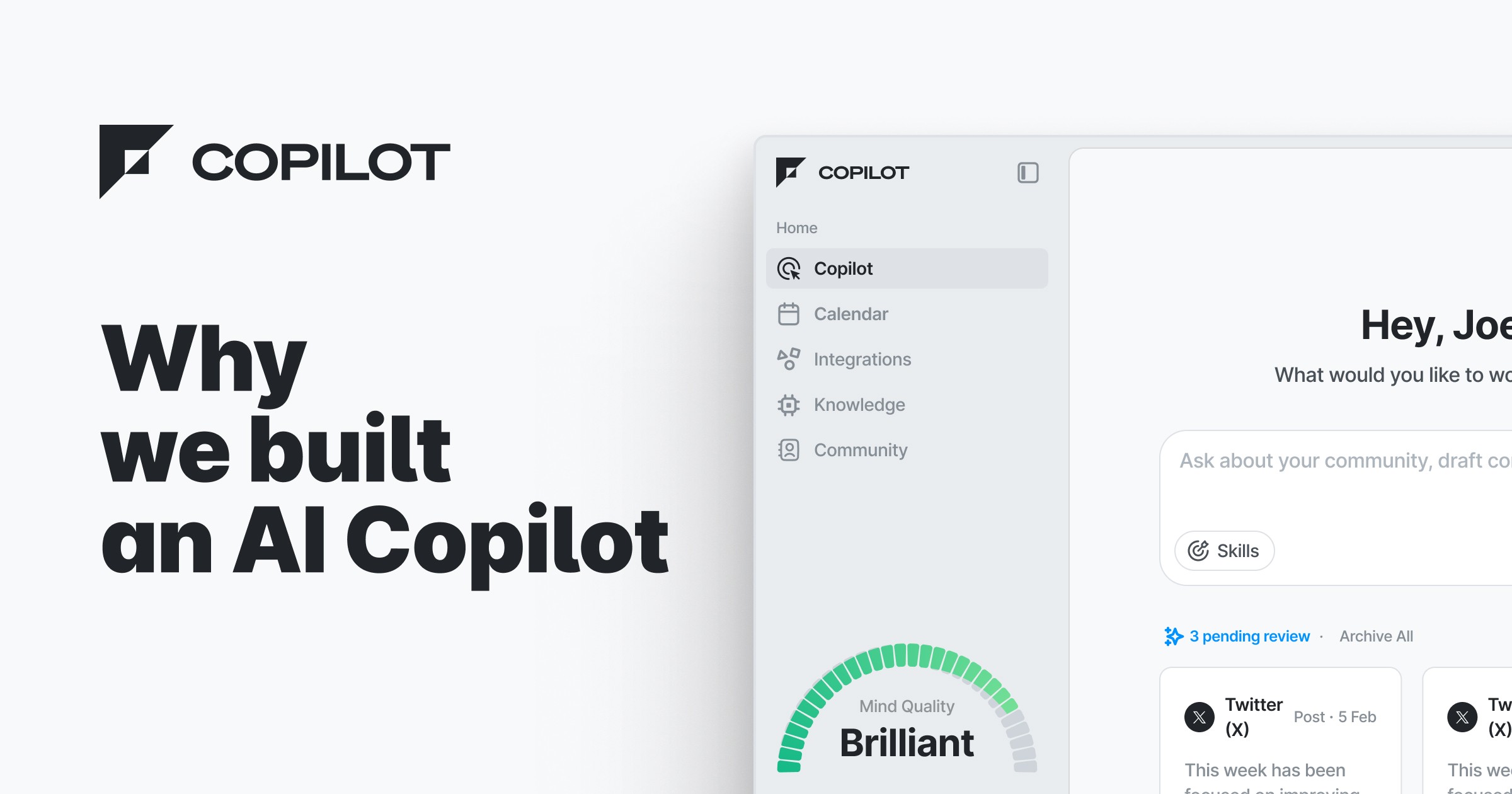
FanBase Copilot is our AI assistant that monitors everything happening within a community - across Discord, X, Twitch, YouTube - and helps orgs act on it. Not a chatbot. Not a content generator. An operational AI agent that watches, learns, and helps community teams work smarter.
We know AI still has negative connotations, especially around content. We hear this a lot. But our belief is that the value isn't in replacing what community managers do well - it's in handling the stuff that drowns them. The monitoring, the reporting, the pattern recognition across thousands of daily interactions that no human can track manually.
Here's what it actually does:
It listens across platforms. FanBase Copilot connects to an org's Discord, X, Twitch, and YouTube. It builds a real-time understanding of what fans are talking about, how sentiment shifts around events, which topics are gaining traction, and who the most engaged community members are - across platforms, not just within one.
It learns the org's voice. The AI analyzes the org's existing content to build an authentic voice profile. When it suggests a tweet, a poll, or a campaign, it sounds like the org - not like a generic AI. Community managers approve and tweak suggestions rather than creating everything from scratch.
It surfaces insights that are hard to see manually. Which fans are active on both Discord and Twitch but have never engaged on X? What sentiment shift happened after last week's roster announcement? Which types of content drive the most cross-platform engagement? These are questions that today require hours of manual data pulling, if they're answered at all. Copilot answers them on demand.
It generates contextual campaigns. Based on what's happening in the community right now - trending topics, upcoming events, sponsor activations - Copilot suggests ready-to-launch campaigns with targeting, messaging, and timing. The community manager's job shifts from "create from scratch" to "approve the best ideas."
The end result for fans is more relevant, more timely, and more personalised experiences. Not because an AI is pretending to be human, but because the humans running the community have better tools to understand what fans actually want.
The synergy between the two products
FanBase apps collect something that social listening tools can't: first-party identity data. When a fan signs up and completes a quest, whether it is to enter a giveaway or level up on a battle pass, they link their gaming accounts, their socials, their Spotify, their Steam. 97% connect at least one account. 42% connect two or more.
Added to FanBase Copilot that monitors when fans engage across socials - this give the most comprehensive overview of a fan base.
Copilot watches a fan being active on Discord and Twitch. The fan app tells you that same person also plays League of Legends 20 hours a week and bought merchandise last month. Suddenly you're not just seeing anonymous engagement - you're seeing a full picture of who your fans are, what they care about, and how they engage across every touchpoint.
This creates a data loop that gets better over time:
The fan app collects deep identity and behavioral data from engaged fans
Copilot monitors cross-platform activity for the entire community
Combined, they build a 360° view of fans that neither could alone
Better fan understanding leads to more relevant activations
Better activations drive more engagement, which creates more data
For fans, this means better experiences. The quests they see are more relevant to their interests. The content the org posts resonates more. The rewards feel more personal. The engagement doesn't stop when the campaign ends because the AI keeps the conversation going in between peaks.
For orgs, it means something they've never had: a unified view of their community across every platform, with the ability to act on it at scale, year-round, without burning out their community team.
What this looks like in practice
An org asks Copilot: "Who are my most active fans across more than two platforms?" - and gets an answer drawn from both platform monitoring and linked account data.
Copilot detects rising sentiment around an upcoming tournament, suggests a campaign with quests tied to the event, targeted at fans who've been most active in the last week. The community manager reviews, tweaks, and launches.
After a roster change, FanBase Copilot surfaces a sentiment report within hours - showing how the community is reacting across platforms, which fan segments are most affected, and suggesting talking points for the org's response.
The community manager's role doesn't disappear. It gets elevated. Less time compiling spreadsheets, more time building genuine connections with fans.
Where we're going
We're currently onboarding orgs and creators to validate how they use the product in practice. Our immediate focus is getting a couple hundred users on the platform to understand real usage patterns before scaling.
If you're running fan engagement for an esports org, a football club, or any fan-driven organisation and this resonates - I'd genuinely love to talk. Not a sales pitch. I just want to hear what problems you're dealing with and show you what we've built.
You can reach me directly here on LinkedIn or check out the product at copilot.fanbase.gg.
We spent two years building the best fan engagement apps we could. FanBase Copilot is the piece that was missing to tie it all together.